Florida: a market Fernanda has worked for over twenty-five years
Florida is the top destination for international property buyers in the United States. For buyers entering the market from outside the country, whether relocating, investing or establishing a permanent base, the difference between a well-made acquisition and a costly one is rarely the property itself. It is the representation behind it.
21%
international property purchases — NAR 2025
$10.4B
International buyer dollar volume — Florida Realtors 2025
+51%
International purchase volume growth YoY — Florida Realtors 2025
45%
Of FL international buyers from Latin America – Florida Realtors 2025
Sources: National Association of Realtors (NAR), Florida Realtors 2025 Profile of International Residential Transactions in Florida.
Why Florida — and why it keeps attracting serious international capital
Florida captures 21 percent of all international property purchases in the United States, more than any other state, according to the National Association of Realtors.
International buyer dollar volume in Florida reached $10.4 billion in the 2025 survey period — a 46 percent increase over the previous year, driven by returning Latin American, Canadian and European buyers who had stepped back during the period of elevated interest rates and economic uncertainty.
The reasons are structural. Florida has no state income tax — a material difference for buyers relocating from high-tax states or high-tax countries. The legal framework for property ownership is transparent and accessible to foreign nationals, with no restrictions on non-citizen purchases.
The state’s population has grown consistently, underpinning residential demand across market cycles. And the lifestyle proposition — year-round climate, international connectivity and the infrastructure of a mature market — drives demand that is not dependent on any single incentive.
Knight Frank identified Florida as one of the world’s top five relocation destinations for high-net-worth individuals in its 2024 Global Wealth Report. Latin American and Caribbean buyers represent 45 percent of Florida’s international buyer pool.
Brazilian buyers spent $762 million on Florida residential property in the 2025 survey period, making Brazil consistently among the top three source countries for international investment in the state.
The Florida buying process — what international buyers need to understand
Buying residential property in Florida as a foreign national is legally straightforward — there are no restrictions on non-citizen ownership, no mandatory local partner structure and no minimum investment requirement.
What requires preparation is not the legal framework but the operational sequence. Each stage has its own requirements and its own window for action.
The acquisition sequence in Florida typically follows these stages:
- Pre-approval or proof of funds: establishes the buyer’s position before any offer is made
- Property search and evaluation: market analysis, community fit, resale logic and condition assessment
- Purchase and Sale Agreement: executed contract that starts the closing timeline
- Title search: confirms clean ownership and identifies any encumbrances
- Inspection: physical condition assessment, typically completed within 10 to 15 days of contract
- HOA documentation review: mandatory for community properties, covers rules, fees and financial health
- Closing: transfer of title, typically 30 to 60 days from executed contract
Buyers who arrive at the Florida process with the following in place move through it more efficiently and with a stronger negotiating position:
- A clear definition of acquisition purpose: primary residence, second home or investment
- Proof of funds or pre-approval documentation from a lender
- A US tax identification number (ITIN) arranged in advance
- A US tax advisor engaged to address FIRPTA implications before the transaction closes
- A defined timeline: the 30 to 60 day closing window requires decisions to be ready
Foreign buyers should be aware of FIRPTA — the Foreign Investment in Real Property Tax Act — which requires a withholding of up to 15 percent of the gross sale price when a foreign national eventually sells a US property. This is not a tax on purchase, but it is a material factor in the long-term financial planning of the acquisition. A qualified US tax advisor should be engaged before any transaction is concluded.
For buyers financing through a US lender, non-resident mortgage options exist but require more documentation than domestic loans — typically two years of tax returns, proof of income in home currency, and larger down payments.
Many international buyers at this level proceed with cash, which simplifies the timeline and strengthens the negotiating position. In either case, having representation in place before the search begins determines the quality of what is accessible and the structure of how it is secured.
Twenty-five years on the ground - not a market Fernanda entered recently.
-Fernanda Silva has been working Florida’s residential market for over 25 years. She arrived in the United States at 16, built her real estate career in Florida from the ground up, and accumulated the kind of market knowledge that only comes from operating inside a market through its different cycles – the growth years, the correction, the recovery and the sustained appreciation that followed. That history is not a credential. It is what the work is made of.
Her practice in Florida is based in Orlando and Central Florida, where she is affiliated with Nova Real Estate. She works exclusively on the buyer side – when she takes on a Florida mandate, her focus is the buyer’s interest, the buyer’s timeline and the buyer’s acquisition strategy. Not a listing, not a development’s inventory, not a commission structure that creates divided loyalties.
For international buyers approaching Florida – whether relocating permanently, establishing a second home or making a capital allocation decision – she brings the same buyer-side rigor she applies in Portugal: market analysis, property evaluation, negotiation and full process coverage from initial search to closing.
Where this market makes sense
Florida tends to be the right market for buyers whose situation aligns with one or more of the following:
- A primary objective of relocation, second home or capital allocation in the United States
- A preference for a market with no state income tax and transparent foreign ownership rules
- A timeline that aligns with the 30 to 60 day closing standard
- An interest in a market with consistent Latin American and international buyer demand
- A capital structure that benefits from a cash purchase or is prepared for US lender documentation requirements

Orlando: where Fernanda's Florida practice is rooted
Orlando is the market Fernanda knows from the inside – the one she built her career in and continues to work actively. Central Florida has developed from a tourism economy into a mature, diversified metropolitan area with a population of over 3.5 million, a growing technology and healthcare sector, and residential communities that attract both domestic relocators and international buyers seeking a permanent base in the United States.
The Orlando – Kissimmee – Sanford MSA represents one of the highest concentrations of Latin American and Caribbean property buyers in Florida. Brazilian, Colombian, Venezuelan and Mexican buyers are consistently among the most active international segments. The communities that attract buyers of this profile – Winter Park, Lake Nona, Dr. Phillips, Isleworth – offer the infrastructure, schools and lifestyle that drive genuine residential decisions, not short-term investment plays.
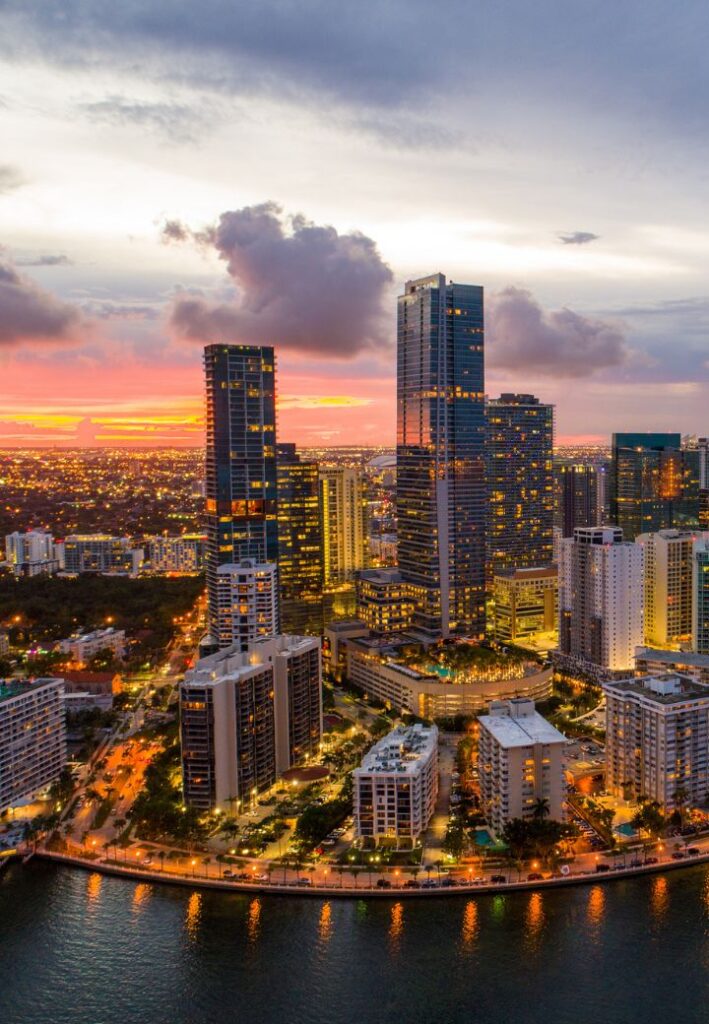
Miami: a market built on international capital
Miami is the most internationally oriented residential market in the United States — a financial and cultural gateway for Latin American, European and Middle Eastern buyers whose demand shapes pricing, inventory and the acquisition process in ways that differ materially from other Florida markets.
Brickell, Coral Gables, Coconut Grove and Miami Beach draw buyers for whom the United States represents both a lifestyle destination and a capital preservation strategy. Brazilian buyers represent one of the most consistent international segments in South Florida — a pattern that reflects cultural proximity, direct flight connectivity and a long-standing Brazilian residential community.
For Fernanda, Miami is a natural extension of the advisory work she already does: cross-market guidance for buyers evaluating the United States as part of a broader portfolio decision, not as a standalone transaction.
Frequently Asked Questions
In a conventional transaction, a real estate agent may represent both the seller and the buyer, or primarily the seller's interest. Buyer-side representation means Fernanda works exclusively on behalf of the buyer at every stage of the process, from market analysis and property evaluation through due diligence coordination and closing. There is no conflict of interest with the seller's side.
Yes. Fernanda maintains an active presence in both markets. In Portugal, she is affiliated with RE/MAX and operates primarily in Lisbon and Cascais. In Florida, she works with Nova Real Estate, with a focus on the Orlando and Miami areas. The advisory approach is consistent across both markets, adapted to each market's specific legal, documentation and negotiation framework.
The starting point is a private consultation designed to establish the buyer's real objectives, capital logic and timeline before any property evaluation begins. This conversation is not a sales meeting. It is a structured session to determine whether working together is the right fit, and what the right acquisition path looks like for that specific buyer, at that moment.
Most real estate transactions in Florida are handled by agents who represent the seller, or who work both sides under a disclosed dual agency arrangement. Buyer-side representation means the advisor works exclusively for the buyer: evaluating properties on the buyer's terms, reading the seller's position independently, and ensuring the process is structured around the buyer's objectives from search through closing. For international buyers unfamiliar with the US market, that exclusive focus is what separates an acquisition that holds up over time from one that does not.
If you are considering an acquisition in Florida – as a primary residence, a second home or a capital allocation decision – the right starting point is a conversation with someone who has worked this market for over two decades.
FAQ - Frequently asked questions
Yes. Florida places no restrictions on foreign nationals purchasing residential or commercial property. Non-citizens can own property outright, with the same rights as US citizens. The main requirements are a US tax identification number and, if financing, meeting lender documentation requirements. Most international buyers at this level purchase with cash, which simplifies the process significantly.
Florida has no state income tax, which is one of its key advantages for international buyers. On purchase, buyers pay documentary stamp taxes on the deed (typically 0.7 percent of the purchase price) and title insurance. The most important tax consideration for foreign buyers is FIRPTA — the Foreign Investment in Real Property Tax Act — which requires withholding of up to 15 percent of the gross sale price when the property is eventually sold. Engaging a qualified US tax advisor before the transaction is essential.
Florida captures 21 percent of all international property purchases in the United States — more than any other state. The combination of no state income tax, a transparent legal framework for foreign ownership, year-round climate, direct international flight connections and a well-established international community makes it the default choice for buyers from Latin America, Canada and Europe. For buyers from Brazil and other Latin American countries in particular, the familiarity of the market, the existing community and the long track record of capital appreciation make Florida a lower-risk US entry point than other states.
For a cash buyer with representation and documentation already in place, the process from executed Purchase and Sale Agreement to closing typically takes 30 to 45 days. Financed transactions add time depending on lender requirements — 45 to 60 days is standard for a domestic loan, longer for international buyers using US financing. The timeline is significantly shorter than Portugal's 60 to 120 day standard, but the due diligence requirements — title search, inspection, HOA documentation review for community properties — are equally important and should not be compressed.
The process is clearer than most buyers expect. The conversation that makes it straightforward is the right next step.